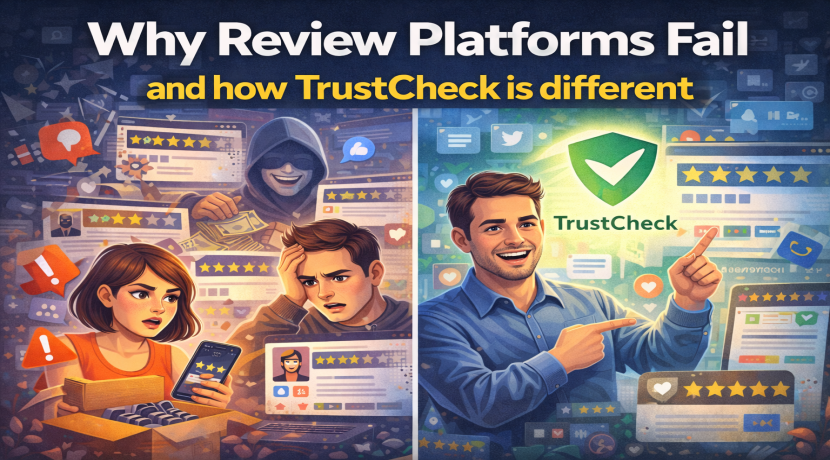
Why Review Platforms Fail (And How TrustCheck Solves What Others Won't)
2026-Jan-24
Every major review platform makes the same fundamental promise: transparency, trust, and authentic community voice. They position themselves as neutral town squares where truth emerges naturally, where excellent businesses rise through consensus, and where bad actors get exposed by collective wisdom.
After years of building and managing review infrastructure across challenging markets, I've watched this promise collapse repeatedly. Not occasionally. Systematically. Users start with optimism, trusting that reviews will clarify decisions and protect them from poor choices. Over time, they discover something different: noise replacing signal, manipulation replacing authenticity, and performative outrage drowning out genuine warnings.
What was designed to reduce uncertainty ends up amplifying it. The very tools meant to build trust become reasons for skepticism. This failure isn't accidental—it's structural, embedded in how most platforms define success and measure growth.
This article examines the core failures plaguing traditional review platforms, why these problems persist, and how TrustCheck was engineered from first principles to solve what established platforms won't address. Understanding these failures helps both businesses and consumers navigate the broken review ecosystem more effectively.
Traffic vs. Truth
Review platforms fail primarily because their incentives are misaligned with user needs. They're built to maximize traffic and engagement, not accuracy or usefulness. This creates predictable distortions that corrupt the entire system.
Engagement beats accuracy. Platforms prioritize reviews that generate clicks, comments, and shares. Emotionally charged, extreme reviews—whether ecstatic praise or furious condemnation—get algorithmic promotion. Measured, nuanced reviews providing specific context get buried. Over time, this rewards performance over reporting.
Volume beats verification. Most platforms celebrate quantity. More reviews mean better rankings, more SEO value, and stronger network effects. This creates pressure to make review submission frictionless, which means eliminating verification steps that would confirm authentic transactions. The result: platforms flooded with unverifiable content.
Virality beats utility. A single outrageous review might generate thousands of views and dozens of responses. A helpful review explaining specific product limitations might get read by twenty people. Platform algorithms optimize for the former, training users to be dramatic rather than useful.
These choices make business sense for platforms chasing growth metrics and advertising revenue. They make terrible sense for users trying to make informed decisions. The gap between platform incentives and user needs explains why review systems consistently disappoint despite decades of iteration.
Identity Weakness
The most fundamental failure of traditional review platforms is treating identity as optional or disposable. This single design choice undermines everything built on top of it.
Most platforms allow reviews with minimal identity verification. Disposable email addresses. Anonymous usernames. No connection to verified transactions. No meaningful cost for creating multiple accounts. This architecture makes deception cheap and trust expensive.
The consequences cascade predictably:
Businesses discover they can manufacture positive reviews at scale. A few hundred dollars buys dozens of five-star testimonials from fake accounts. Overnight, reputation becomes purchasable rather than earned. Legitimate businesses competing against fraudulent ratings face impossible choices: join the manipulation or accept algorithmic burial.
Competitors weaponize the same weakness. Sabotage reviews from anonymous accounts damage rivals without accountability. Since platforms can't reliably connect reviews to real transactions, distinguishing genuine complaints from competitive attacks becomes guesswork.
Consumers learn that nothing can be trusted at face value. That five-star average might be real or fabricated. That one-star review might be justified or malicious. Every review requires mental discounting, defeating the purpose of review systems entirely.
The platform response is typically algorithmic filtering machine learning trying to detect fake patterns. This creates an arms race: fraudsters evolve tactics, algorithms chase them, and legitimate users get caught in crossfire when the filters flag real reviews as suspicious.
In markets like Ghana where TrustCheck operates, identity weakness hits harder. Limited consumer protection infrastructure means review platforms should compensate for institutional gaps. Instead, weak identity verification amplifies existing trust deficits. People already skeptical of online commerce find their caution confirmed by obviously manipulated review sections.
Flattening Complexity Into Stars
Traditional review platforms compress complex, multidimensional transactions into single-dimensional star ratings. This reductionism destroys the information consumers actually need.
Five stars. One star. Good. Bad. The nuance of real commercial interactions disappears entirely. Consider what gets flattened:
A delayed delivery due to courier issues sits visually identical to outright fraud. A product that works perfectly but arrived with damaged packaging gets the same one-star as a product that never functioned. A business that resolved a problem quickly after initial failure looks identical to one that ghosted customers entirely.
Readers scanning star averages cannot distinguish between these vastly different scenarios. They cannot assess whether the problems described match their risk tolerance or use case. They cannot determine if issues were resolved or remain systemic.
Platforms rarely capture essential context:
- How was payment made? (Cash on delivery creates different risk than prepayment)
- Was the issue resolved? (Initial failure with good recovery differs from abandoned customers)
- Is this a first-time buyer? (New customers judge differently than repeat buyers)
- What was the specific failure point? (Shipping, product quality, customer service, payment processing?)
- Has the business changed since this review? (Reviews from two years ago may not reflect current operations)
This context would dramatically improve review usefulness. A consumer could filter for "resolved issues" versus "unresolved issues," or see patterns like "great product quality, consistently slow shipping." They could make informed tradeoffs rather than binary decisions.
But detailed context reduces engagement. It requires more effort from reviewers. It creates longer review pages that people might not scroll through completely. It complicates the simple, addictive experience of scanning star ratings.
So platforms optimize for simplicity over usefulness. They choose engagement metrics over decision quality. Users adapt by learning to distrust the simplified signals they're given.
The Quiet Disaster Nobody Discusses
Content moderation on review platforms represents a sustained failure that rarely gets examined because it happens invisibly, case by case, without pattern analysis or accountability.
Platforms face an impossible balance: remove too little and harmful content proliferates; remove too much and legitimate voices get silenced. Most platforms fail at both simultaneously through opaque, inconsistent processes.
Over-policing legitimate criticism. Businesses dispute negative reviews claiming policy violations. Platform moderators, often undertrained and overworked, make quick decisions based on keywords rather than context. Legitimate reviews mentioning specific problems get removed for vague reasons like "violates community standards" or "potentially defamatory." Appeals are slow when they exist at all.
Under-policing actual violations. Meanwhile, clearly malicious content survives because it generates engagement. Personal attacks, profanity-laden rants, and competitor sabotage remain visible for weeks or months. Users reporting violations receive automated responses but rarely see action.
The visibility paradox. Controversial reviews drive traffic. Platforms have financial incentives to keep engagement-generating content visible even when it violates stated policies. The most measured, policy-compliant reviews contribute least to platform metrics.
Users learn that moderation feels arbitrary. The same type of review gets removed one day and approved the next. Businesses learn that aggressive disputes sometimes work through volume and persistence rather than merit. Trust in the system erodes quietly.
In developing markets where TrustCheck operates, moderation failures carry extra weight. Users have fewer alternative accountability mechanisms. A removed review might represent their only attempted recourse. When platforms delete legitimate complaints or ignore malicious ones, they're not just making moderation errors—they're failing to provide the institutional support their markets desperately need.
Documentation Without Deterrence
Perhaps the most profound failure of traditional review platforms is that nothing meaningful happens after reviews are posted. They document harm without reducing it.
Patterns remain invisible. A business might accumulate fifty reviews describing the same problem—consistently late delivery, unresponsive customer service, products not matching descriptions. These patterns exist in aggregate data but rarely surface clearly to users. Each reviewer thinks they're reporting an isolated incident. Each potential customer sees a scattered collection of complaints without recognizing the systemic issue.
Repeat offenders aren't flagged. Platforms almost never implement meaningful consequences for businesses or users showing persistent bad behavior. A company with two years of complaints about non-delivery continues operating with the same visibility as a legitimate business. A user creating obvious fake reviews faces no escalating consequences after each detected violation.
Resolution isn't tracked. When a business fixes a problem or compensates a customer, this rarely updates the review's context. Future readers see the initial complaint without knowing it was resolved. Businesses handling issues responsibly get no algorithmic credit. The incentive to resolve disputes decreases.
Prevention doesn't improve. Review platforms collect massive datasets about fraud patterns, common business failures, and consumer vulnerability points. This data could inform warnings, educational content, or proactive interventions. Instead, it sits unused while the same scams repeat across thousands of victims.
This creates learned helplessness. Users post reviews expecting nothing beyond venting frustration. They don't expect intervention, pattern recognition, or actual protection. Reviews become therapeutic release rather than accountability mechanisms.
For businesses, the lack of consequence means reputation management becomes purely defensive—deleting or disputing reviews rather than improving operations. The platform records failure without incentivizing change.
How Weak Platforms Amplify Weak Institutions
In markets with strong consumer protection robust legal systems, active regulatory agencies, efficient dispute resolution—review platforms serve as supplementary information sources. Their failures frustrate users but don't leave them defenseless.
In markets like Ghana and much of West Africa where TrustCheck focuses, institutional consumer protection is limited. Legal recourse is expensive and uncertain. Regulatory enforcement is inconsistent. Small-value disputes have no practical resolution path.
Review platforms should compensate for these gaps. Instead, traditional platforms amplify them by creating the illusion of accountability without delivering substance. This false promise is worse than silence.
The dangerous pattern
A consumer gets defrauded. They post a detailed review warning others. The platform displays it alongside hundreds of other reviews. Nothing else happens. The fraudulent business continues operating. More people get victimized. More reviews appear. The cycle continues.
The platform has documented harm extensively without preventing a single additional victim. Worse, victims believed they were contributing to a protective system. They invested time writing reviews thinking it would trigger consequences. Their effort was wasted, and the disappointment compounds their original loss.
This failure transforms review platforms from accountability tools into catalogues of ongoing harm. They become places to confirm suspicions after getting hurt rather than resources preventing harm before it happens.
How TrustCheck Approaches the Problem Differently
TrustCheck was built from the recognition that trust isn't automatic—it's engineered deliberately through intentional design choices that cost engagement and traffic in exchange for usefulness and protection.
Identity and Traceability: Making Deception Costly
TrustCheck emphasizes verifiable identity without unnecessary exposure. Reviews are connected to real transactions, verified interactions, or documented context that makes casual deception expensive.
This doesn't mean forcing users to publicly expose personal information. It means requiring evidence of actual commercial interaction before a review can affect a business's reputation. A review tied to a confirmed transaction carries weight. An anonymous complaint from an unverifiable source doesn't.
This architecture flips the economics of fake reviews. Creating fraudulent reviews requires fabricating transaction evidence, which costs significantly more than creating email accounts. The return on investment for review manipulation plummets. Truth becomes easier than fiction.
For legitimate reviewers, this verification process adds a minor step that dramatically increases their review's credibility and impact. Most users willingly provide purchase confirmations or interaction evidence when they understand it strengthens their voice.
Context as Structure: Reviews as Evidence, Not Content
TrustCheck treats reviews as structured evidence rather than free-form content. Reviewers are guided through questions capturing the information readers actually need:
- What specific transaction occurred?
- How was payment handled?
- What exactly failed or succeeded?
- Was the issue communicated to the business?
- How did the business respond?
- Was resolution attempted or achieved?
This transforms reviews from emotional reactions into systematic records. A reader can filter for "unresolved payment disputes" versus "slow shipping with good communication" versus "product quality issues." They can assess whether documented problems match their risk tolerance.
The structured approach also reduces noise. Generic complaints like "terrible service" become specific claims like "order #12345 placed January 5, received damaged product, business did not respond to three emails over 14 days." Specific claims can be verified, disputed with evidence, or acknowledged. Vague complaints cannot.
This structure costs engagement. It requires more effort from reviewers. It produces longer, denser review pages. But it delivers dramatically higher decision-making value. TrustCheck optimizes for usefulness rather than traffic metrics.
Pattern Recognition Over Star Averages
TrustCheck surfaces behavioral patterns rather than reducing businesses to average ratings. The platform highlights:
- 1. Consistency over time: Does this business reliably deliver, or do performance levels fluctuate?
- 2. Response patterns: How quickly and effectively does the business address problems?
- 3. Resolution rates: What percentage of issues get resolved satisfactorily?
- 4. Specific weakness areas: Is the problem product quality, shipping, payment processing, or customer service?
One review can be unfair, mistaken, or represent an outlier situation. Ten reviews showing the same pattern tell a reliable story. TrustCheck's interface makes these patterns visible at a glance.
This approach requires sophisticated data presentation and algorithm design. It's harder to build than simple star averages. But it reflects how trust actually forms through observation of consistent behavior rather than single data points.
Transparent, Purposeful Moderation
TrustCheck's moderation philosophy is straightforward: preserve usefulness, discourage harm, operate transparently.
Reviews are guided, not censored. The platform encourages evidence-based reporting and discourages personal attacks or irrelevant tangents. Moderation focuses on maintaining structured format rather than suppressing negativity.
Decisions are explained. When a review is modified or removed, both the reviewer and the business receive clear explanation citing specific policy sections. Appeals go to humans who explain their reasoning.
Patterns trigger intervention. A business receiving multiple similar complaints might receive outreach offering to facilitate resolution. A reviewer flagged for possible manipulation gets verification requests rather than immediate deletion.
Accepting Platform Responsibility
Most review platforms claim neutrality as a shield from accountability. They argue they merely host content created by others. TrustCheck rejects this framing entirely.
Hosting reviews shapes markets. It influences which businesses succeed and which fail. It protects some consumers while leaving others vulnerable. These effects are real regardless of claims about neutrality.
TrustCheck accepts responsibility for the market dynamics it creates. This means:
- 1. Actively working to surface patterns that warn consumers
- 2. Facilitating (not just documenting) dispute resolution where possible
- 3. Removing businesses that demonstrate sustained fraud after documentation
- 4. Continuously improving verification to reduce manipulation
- 5. Using aggregated data to educate consumers about common risks
This approach costs more to operate and creates more legal surface area. It's the correct approach anyway because it aligns platform success with user protection rather than mere engagement.
Why Most Platforms Won't Fix These Problems
The failures described here aren't secrets. Platform operators understand these issues. So why don't established platforms fix them?
Fixing these problems reduces metrics. Verification friction decreases review volume. Structured reviews reduce casual participation. Pattern-focused interfaces make pages more complex. Responsible moderation requires expensive human oversight. All of these choices hurt the engagement metrics that platforms report to advertisers and investors.
Network effects protect incumbents. Established platforms have millions of reviews already. Businesses and consumers use them despite frustration because everyone else does. This installed base protects them from competitive pressure to improve quality.
The business model depends on current design. Review platforms monetize through advertising, premium business accounts, and lead generation. These revenue streams depend on high traffic volumes and business anxiety about reputation. Fixing core trust problems might reduce both.
Legal liability increases with responsibility. Claiming neutrality provides legal protection. Accepting responsibility for market outcomes creates liability exposure. Most platforms choose the legal safety of claiming they're just hosting content others create.
These aren't excuses—they're explanations for why structural problems persist despite obvious solutions. Established platforms optimize for different goals than user trust.
Building Trust as Infrastructure
TrustCheck operates from a fundamentally different assumption: trust is infrastructure, not decoration. It's something you engineer carefully, maintain actively, and invest in systematically.
Infrastructure costs money and effort. It requires ongoing maintenance. It constrains other design choices. But it enables everything built on top of it. Roads, electrical grids, water systems—societies invest in these because the alternatives are worse.
Trust infrastructure works the same way. The verification systems, structured data collection, pattern recognition algorithms, and transparent moderation processes that TrustCheck maintains cost significantly more than simple star ratings and anonymous comments.
But they enable something more valuable: actual decision-making confidence. Users can assess risk meaningfully rather than guessing. Businesses get feedback they can act on rather than generic complaints. Patterns surface before they become crises.
This is especially critical in markets where formal institutional protection is weak. When courts are slow, regulators are under-resourced, and enforcement is uncertain, private platforms providing reliable accountability become essential infrastructure rather than optional conveniences.
Final Thoughts: The Choice Platforms Make
Review platforms fail when they prioritize engagement over accuracy, traffic over trust, and growth over usefulness. These failures aren't inevitable—they're choices driven by business models that profit from the appearance of accountability without its substance.
Most platforms won't change because the current broken system serves their incentives adequately. They extract value from the trust gap rather than closing it. They document harm without preventing it. They promise transparency while delivering opacity.
TrustCheck exists because someone needed to build the platform that should exist rather than the one that maximizes ad revenue. It's engineered for markets where trust is scarce, institutions are weak, and the cost of bad decisions is high.
The design choices—verified identity, structured context, pattern recognition, transparent moderation, accepted responsibility—all reduce certain metrics while improving actual usefulness. This tradeoff is intentional.
Trust isn't automatic. It's not created by hosting reviews and hoping truth emerges naturally. It's built deliberately through systems that make truth easier than fiction, accountability visible, and deception expensive.
That's the infrastructure TrustCheck provides. Not perfect, because no system is. But honest about its goals, transparent about its methods, and aligned with user protection rather than just engagement metrics.
In environments where trust is already fragile, this difference matters enormously. It's the difference between a platform that documents harm and one that actually reduces it.
About TrustCheck
TrustCheck is a review and reputation platform built specifically for markets where traditional consumer protection infrastructure is limited. Operating primarily across Ghana and West Africa, TrustCheck emphasizes verified transactions, structured evidence, and pattern recognition to create accountability where institutional support is weak. Learn more at www.trustcheckapp.com.
Frequently Asked Questions
How does TrustCheck verify that reviews are from real customers? We require evidence of actual transactions or interactions before reviews can be published. This might include purchase confirmations, order numbers, communication records, or other documentation proving the commercial relationship occurred. This verification prevents anonymous, unverifiable complaints from affecting business reputations.
Can businesses remove negative reviews on TrustCheck? Businesses cannot directly remove reviews. They can dispute reviews they believe are factually incorrect or violate policies by providing counter-evidence. Our moderation team reviews disputes with transparency, explaining decisions to both parties. The goal is accuracy, not protecting businesses from legitimate criticism.
What makes TrustCheck different from Google Reviews or Yelp? TrustCheck emphasizes structured evidence over star ratings, patterns over individual reviews, and verification over volume. We operate with explicit acknowledgment that platforms shape markets and accept responsibility for those effects. We're also built specifically for markets where institutional consumer protection is limited.
Does requiring verification reduce the number of reviews? Yes, and that's intentional. We optimize for review quality and usefulness rather than quantity. Ten verified, structured reviews provide more decision-making value than one hundred unverified star ratings.
How does TrustCheck handle disputes between customers and businesses? We provide structured communication channels and, where possible, facilitate resolution rather than just documenting complaints. Our system tracks whether issues were resolved, how businesses responded, and what patterns emerge over time.
Is TrustCheck only for Ghana? TrustCheck was built for markets with limited consumer protection infrastructure, with initial focus on Ghana and West Africa. The platform's design—emphasizing verification, structure, and accountability—addresses challenges common across emerging economies, but our approach benefits users anywhere that traditional review platforms prove inadequate.
Can I trust TrustCheck reviews more than reviews on other platforms? Our verification and structure requirements make deception significantly more expensive, which improves average review reliability. However, no system is perfect. We're transparent about our methods and limitations rather than claiming absolute accuracy. Our goal is to be measurably more reliable than alternatives, not perfectly reliable in all cases.
Comments
Comments are reviewed before they appear publicly.
Sign in to leave a comment.
Sign inNo comments yet. Be the first to leave one.