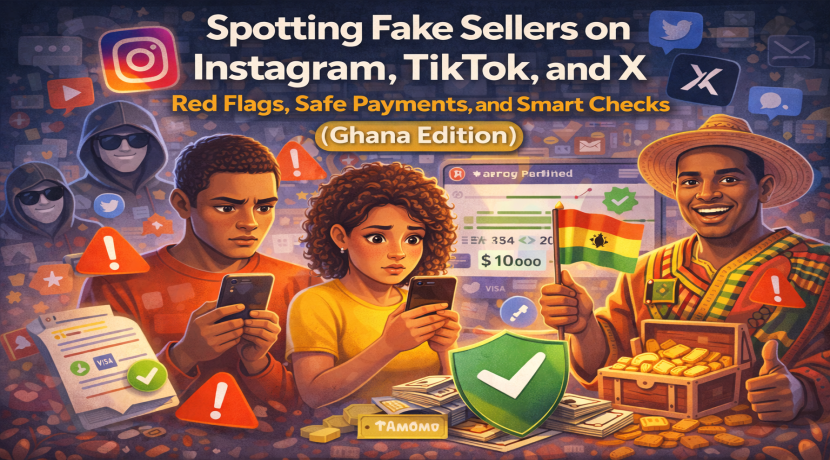
Spotting Fake Sellers on Instagram, TikTok, and X: Red Flags, Safe Payments, and Smart Checks (Ghana Edition)
2026-Jan-14
A seller posts a clean video. Good lighting. New iPhone. Price slightly too good. Comments full of fire emojis and “DM sent.” The bio says Accra. Or maybe Kumasi. Or nowhere at all.
Payment is requested quickly. Transfer now. Delivery later. Trust me.
People lose money every day to fake online sellers in Ghana. Not because they are stupid. Because the environment trains them to move fast, hope fast, and trust thin signals.
Online marketplaces on Instagram, TikTok, and X do not feel like markets. They feel like streets without pavements. Everyone walks where they can. Everyone watches everyone else. Everyone learns by bruises.
From a distance, the advice sounds easy. Be careful. Verify sellers. Use secure payment methods.
From inside the system, things move differently. Phones buzz. Prices change. Sellers disappear. Someone else grabs the item. Delay becomes loss. Caution becomes regret.
This is how online scams in Ghana work. Not on lies alone. On pressure.
Common Red Flags of Fake Sellers in Ghana
1. Urgency That Pushes You to Pay Fast
The first red flag is urgency. Not loud urgency. Calm urgency.
“Two people are interested.”
“Pay now so I can reserve it.”
“The delivery rider is already waiting.”
In Ghana, urgency works because scarcity is familiar. Fuel runs out. Network drops. Lights go off. Things vanish. When someone says act now, the body already knows how to obey.
Fake sellers rely on this reflex.
2. Social Media Profiles That Look Legit but Prove Nothing
A profile with thousands of followers. Old posts. Testimonials in screenshots.
None of these confirm legitimacy.
Followers are bought. Screenshots are recycled. Old posts mean nothing if the account changed hands. On Instagram, TikTok, and X, identity is a costume shop.
If the seller’s history does not show consistent selling behavior, assume risk.
3. Payment Methods That Leave You Powerless
The third red flag is payment direction.
Fake sellers avoid any method that creates friction.
No cash on delivery.
No physical pickup.
No platform checkout.
Only direct transfer. Mobile money. Bank transfer.
Once sent, the story ends. No reversal. No appeal. Silence becomes the customer support desk.
Why Online Scams Are So Common in Ghana
People ask why buyers still fall for scams on social media. The better question is why the system keeps rewarding speed over safety.
In Ghana, safe systems are rare. Platforms disclaim responsibility. Banks move slowly. Police reports feel ceremonial. Everyone knows this.
So people adapt.
They rely on gut feeling. On vibes. On social proof. On hope.
Online fraud is not an exception. It is continuity.
Fake sellers understand this environment better than anyone else.
How to Verify a Seller Before Paying
Real sellers tolerate friction. Fake sellers do not. Use these checks before sending money.
Ask for Physical Presence
Request a pickup location, even if you do not plan to go. A real seller gives a place. A fake seller gives a story.
Request a Live Video Call
Ask for a live video showing the item while saying today’s date. Not a recorded clip. Not reposted content. Live presence. Scammers avoid presence.
Check Account Consistency
Look for alignment over time. Same products. Same location signals. Same tone.
Sudden pivots are warning signs.
Reverse Image Search Product Photos
Many scam images come from Jumia, Amazon, or foreign listings. If the same image appears elsewhere, walk away.
Safe Payment Options in Ghana
If none of these are available, understand the risk clearly.
Cash on delivery
Physical pickup and inspection
Escrow services
Platform managed checkout
If a seller refuses all protective options, the transaction is a gamble. Do not pretend otherwise.
The Real Cost of Speed
Scams feed on urgency and shame.
The fear of missing out.
The embarrassment of asking questions.
The need to look sharp.
Smart buyers are not silent. They are annoying.
Platforms will tell you to report and move on. That advice comes after loss. Prevention lives earlier. In delay. In discomfort. In walking away.
A system that does not punish fraud will produce excellent fraudsters.
A system that does not protect buyers will train buyers to gamble.
So fake sellers thrive. Not because Ghanaians are naïve. But because the environment teaches the same lesson repeatedly.
Move fast or lose out. Trust thin signals. Hope for the best.
Until enforcement, platforms, and payment systems improve, the burden stays with the buyer. Not morally. Practically.
Slow down. Add friction. Demand proof. Walk away often.
Comments
Comments are reviewed before they appear publicly.
Sign in to leave a comment.
Sign inNo comments yet. Be the first to leave one.