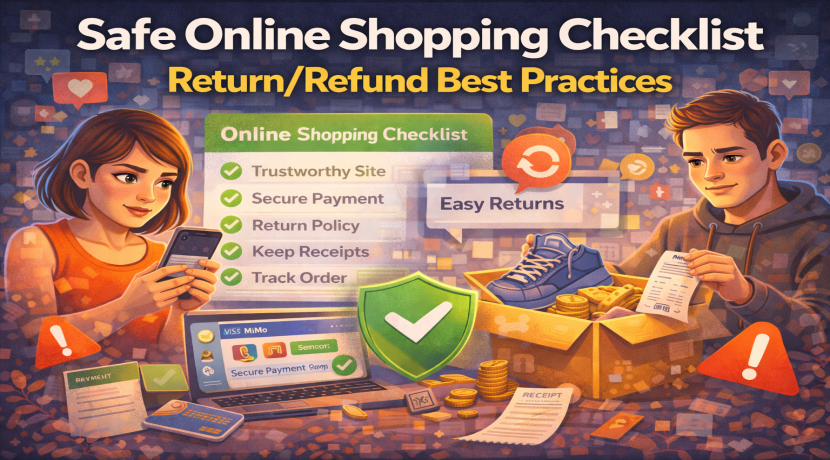
Safe online shopping checklist, return/refund best practices
2026-Jan-24
Online shopping begins with optimism. A product photo. A promise. A price that feels fair. Sometimes even generous. The transaction feels simple. Click. Pay. Wait. What people discover later is that the danger is not in the buying. It is in everything that happens after the money leaves their hand.
Most losses do not come from obvious scams. They come from small assumptions. That delivery timelines are real. That return policies mean something. That a refund promise is binding. In Ghana, these assumptions are expensive. Not because sellers are uniquely dishonest, but because systems rarely force accountability. When protection is weak, preparation becomes survival.
A safe online shopping checklist is not paranoia. It is adaptation. It begins before payment, not after disappointment. The first question is not whether the product is good. It is whether the seller can be held to anything. A real business leaves traces. A physical address. A working phone number. A history that aligns over time. Not just testimonials, but patterns. What does the seller do when customers complain. Do they respond. Do they disappear. Do they blame.
Payment terms reveal more than branding ever will. Sellers who insist on full payment upfront without inspection are transferring all risk to the buyer. Sometimes this is unavoidable. When it is, the buyer should treat the transaction as fragile. Reduce the amount. Split payments. Use methods that leave records. If no protective option exists, recognize that you are gambling, not shopping.
Delivery promises should be treated as hypotheses, not guarantees. Ask how delivery works. Who delivers. What happens if the item is damaged. What happens if it never arrives. A seller who cannot answer these questions clearly has not thought about your protection. They have only thought about collection.
Return and refund policies are the sharpest test of legitimacy. Many sellers list them because they sound professional, not because they intend to honor them. A real return policy has conditions, timelines, and process. How many days. What qualifies. Who pays for return shipping. How refunds are issued. Silence or vagueness here is a warning sign. If a seller becomes irritated when asked about refunds, the conversation has already ended.
Buyers should document everything. Screenshots of product descriptions. Payment confirmations. Delivery messages. Dates. Names. Not because you expect a fight, but because memory fades and proof does not. Documentation turns a complaint into a case. Without it, even a legitimate grievance becomes difficult to defend.
Inspection is not disrespect. It is responsibility. If cash on delivery is available, inspect before releasing payment. If inspection is rushed or discouraged, pause. Pressure during inspection usually means something is being hidden. Legitimate sellers understand caution. Fraudulent ones rely on speed.
Refund best practices begin with realism. Refunds are not favors. They are obligations. But in environments where enforcement is weak, obligations only matter if they are visible and traceable.
Ask how long refunds take. Ask whether refunds go back to the same payment method. Avoid arrangements that require goodwill alone. Goodwill evaporates quickly after money moves.
Many buyers hesitate to ask questions because they fear appearing difficult. This fear is misplaced. Scammers count on politeness. Legitimate sellers respect scrutiny. The ability to ask, pause, and walk away is your leverage. Once payment is made, leverage collapses.
The deeper truth is that online shopping safety is not about avoiding all risk. It is about controlling exposure. Spend less on first transactions. Test sellers with small purchases. Observe behavior over time. Trust should be incremental. Anyone demanding full trust upfront is asking for something they have not earned.
In systems where refunds are uncertain and returns are costly, prevention carries more value than recovery. The checklist exists to reduce regret, not to eliminate it entirely. It teaches buyers to slow down in environments that reward speed and punish caution.
Comments
Comments are reviewed before they appear publicly.
Sign in to leave a comment.
Sign inNo comments yet. Be the first to leave one.