A message comes in. It looks official. The logo is familiar. The language is polite, almost reassuring. “Your account has been limited.” “Confirm your details to avoid suspension.” A link follows. It feels routine. People tap without thinking. Minutes later, the balance is gone. The number no longer connects. The page disappears. What remains is confusion, then shame, then silence.
This is how most online scams in Ghana begin. Not with drama. With normality. With things that look like daily life. Mobile money alerts. Delivery updates. Bank notices. The fraud works because it blends into habits people already have. It does not introduce itself as danger. It introduces itself as administration.
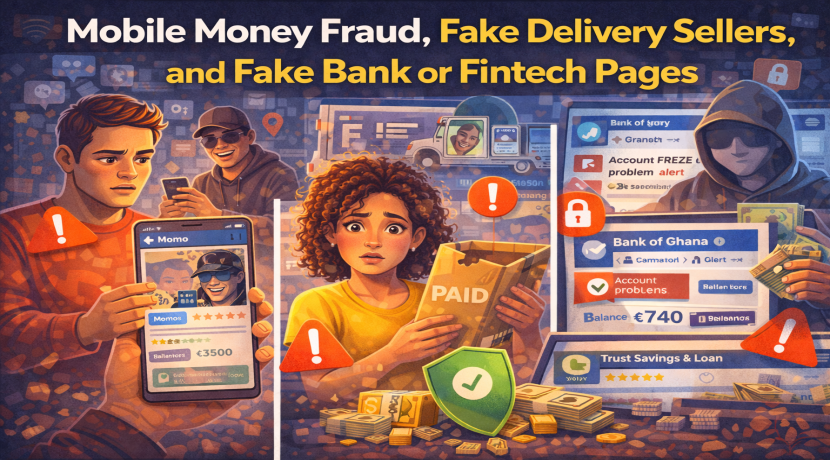
Mobile money scams thrive because mobile money has become infrastructure. It pays rent. It buys food. It funds businesses. It replaces cash, queues, and banks for millions of people. When something becomes this central, it also becomes attractive to abuse. Scammers understand this. They impersonate agents. They spoof customer care numbers. They send reversal requests that look procedural. They pressure people to act quickly because delay feels risky. When money moves instantly but protection does not, speed becomes both the benefit and the trap.
Delivery and marketplace scams follow the same logic. A product is advertised. The price is competitive. The seller claims stock is limited. Payment is requested upfront. The buyer pays because they have been trained to. In Ghana, waiting often means nothing happens. Services do not move until money moves. Scammers copy this pattern and weaponize it. After payment, delivery is postponed. Excuses stack up. Network issues. Rider problems. Family emergencies. Then the account blocks you. The business page vanishes. What looked like commerce was only theater.
Fake bank and fintech pages complete the triangle. These pages look professional because professionalism is cheap online. Logos are copied. Fonts are matched. Names are slightly altered. A missing letter. An extra underscore. A sponsored post appears on social media promising account upgrades, compensation, or urgent security verification. People click because the platform itself looks legitimate. They trust the environment more than they should. Once credentials are entered, the damage is already done.
People often ask why these scams keep working. The answer is not ignorance. It is incentives. Recovery is rare. Enforcement is slow. Reporting feels pointless. The cost of fraud is carried privately, while the benefit flows quickly to the scammer. This imbalance trains both sides. Scammers refine their techniques. Victims learn to stay quiet. Shame becomes part of the system. It keeps losses invisible and patterns unchallenged.
The warning signs are consistent, even when the stories change. Any message that creates urgency without offering verification is suspect. Any request for PINs, one time passwords, or login details is a trap. Any page that pushes you off the official app into a link should be treated as hostile. Real institutions do not rush you through insecurity. They do not threaten you with sudden closure through DMs. They do not need your password to help you.
Protection starts with slowing things down. Check the sender carefully. Compare numbers with official contacts. Open your bank or fintech app directly instead of clicking links. Call customer support through verified channels. For deliveries and marketplaces, insist on physical verification where possible. Cash on delivery. Pickup points. Platform mediated payments. If none exist, understand that you are gambling, not transacting.
Most importantly, separate politeness from safety. Scammers exploit good manners. They sound respectful. They call you “sir” or “madam.” They use local language. They reference God. None of this is proof. Safety is built on process, not tone. If a transaction does not allow you to pause, check, and confirm, it is designed to defeat you.
The hard truth is that a system that does not reliably reverse fraud will produce excellent fraudsters. A system that treats victims as careless will teach them to absorb losses quietly. And a system that allows fake pages to advertise alongside real institutions will blur trust until everything looks optional. In such an environment, vigilance becomes a personal duty, not a shared one.
People are not losing money because they are foolish. They are losing money because the digital economy moved faster than protection, faster than enforcement, faster than literacy. Until those gaps close, survival depends on suspicion. On patience. On being willing to slow down when everything pushes you to move fast.
Comments
Comments are reviewed before they appear publicly.
Sign in to leave a comment.
Sign inNo comments yet. Be the first to leave one.